How to Re-Engage Cold B2B Leads and Restart Sales Conversations
A cold lead isn’t necessarily a lost opportunity. For UK technology, SaaS and IT sales teams, silence may point to poor timing, a message that missed the mark or a business need that has changed. The challenge is knowing which explanation fits before another generic follow-up lands in the prospect’s inbox. Effective strategies for re-engaging cold leads start with context, not guesswork.
If your team is revisiting old CRM records without a clear reason to make contact, you’re not alone. Repeated messages can use up valuable sales time without revealing whether an opportunity still exists. A more deliberate approach helps you decide which leads merit attention and gives each conversation a relevant purpose.
This guide explains how to review past interactions, spot useful changes in a prospect’s business and reopen the conversation with a clear reason to speak. You’ll also learn how to record outcomes, so each response, including a request to reconnect later, informs the next follow-up and improves pipeline visibility.
Key Takeaways
- Distinguish a quiet prospect from a poor-fit account by checking for changes in timing, relevance, access or business priorities.
- Use strategies for re-engaging cold leads that begin with the last meaningful interaction and give the prospect a clear reason to respond.
- Tailor your message to the contact’s role, known concerns and decision process rather than sending another generic follow-up.
- Apply a practical recovery framework to review lead context, restart conversations and record outcomes that inform future follow-up.
- Assess campaign evidence carefully: separate illustrative scenarios from verified results and avoid treating re-engagement as a guaranteed outcome.
What cold leads mean in B2B sales, and why they deserve a second look
A cold lead is a prospect who has stopped responding or progressing in the sales pipeline; cold status describes recent engagement, not the prospect’s fit or potential. That distinction matters in technology sales, where a purchase may involve several stakeholders, technical evaluation and shifting priorities. A stalled conversation doesn’t, by itself, tell you whether the prospect has lost interest, lacks a current need or simply can’t act yet.
Treating every quiet record as either an active opportunity or a dead end creates problems. Contacting someone without understanding the last conversation can waste sales capacity and make your follow-up feel disconnected. Before deciding whether to re-engage, use the available history to identify what changed, what remains uncertain and whether there’s a relevant reason to speak now. That disciplined review is central to effective strategies for re-engaging cold leads.
How a lead becomes cold in a technology sales pipeline
A prospect may go quiet after an initial discussion, a product demonstration, a technical review or a proposal. Each stall point has a different possible explanation. A project might have moved to a later planning cycle, an internal sponsor may have changed roles, or a technical team may be evaluating another priority. A delayed timeline doesn’t necessarily mean the need has disappeared.
Context can also decay. Notes that record only “follow up later” won’t tell a colleague what prompted the conversation, who was involved or what the prospect wanted to resolve. Revisit the original need, the last agreed action and any known change before drafting a message. For background on the difference between initial cold outreach and contacting a known prospect, see Understanding Cold Calling.
Cold, unresponsive or disqualified: what is the difference?
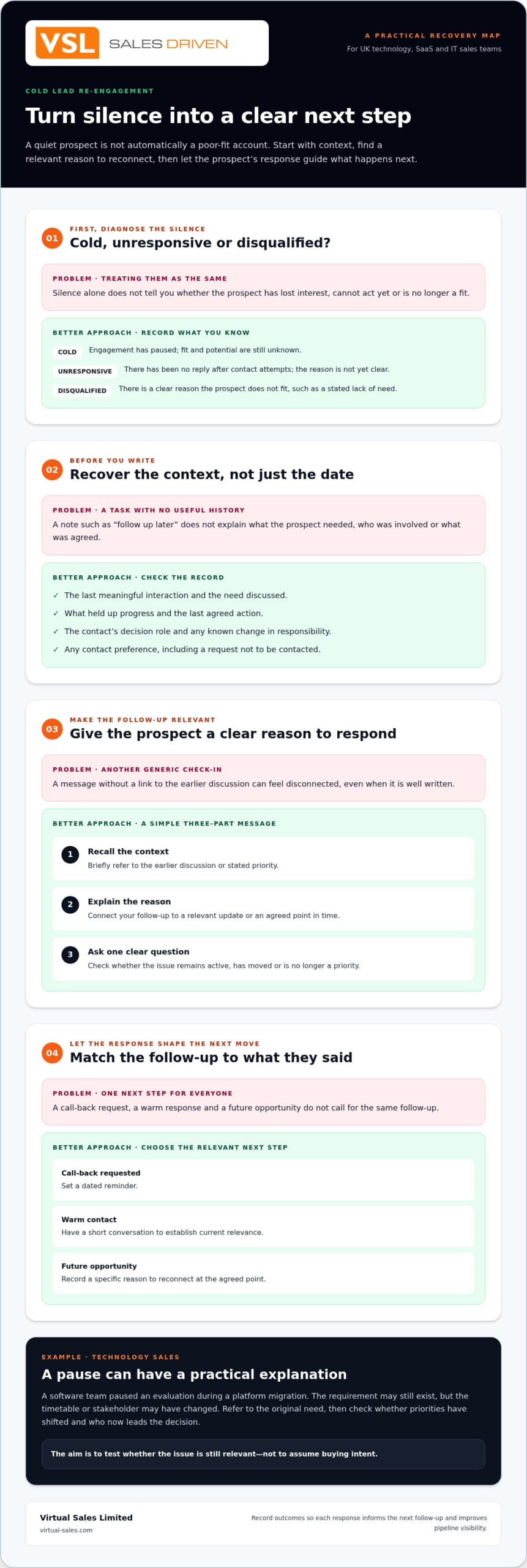
Cold means engagement has paused. Unresponsive describes a lack of reply after contact attempts, but doesn’t explain why. Disqualified means there’s a clear reason the prospect doesn’t fit, such as a stated lack of need or a mismatch with your ideal customer profile. Keep these distinctions clear in your CRM so that silence alone doesn’t become a reason to remove a potentially suitable account.
Before renewed contact, check the record for the last known need, the contact’s decision role and the next action agreed. If the contact has moved on, the original decision-maker may no longer be the right person. If the prospect asked not to be contacted, respect that instruction and follow your organisation’s contact preferences and data-handling process.
Re-engagement should test whether the issue is still relevant, not assume buying intent. For example, a software team that paused an evaluation during a platform migration may still have the same requirement, but a different timetable or stakeholder. A brief, informed conversation can establish whether priorities have shifted, whether someone else now leads the decision and whether a next step makes sense.
For technology firms reviewing a wider prospect database, lead generation for technology companies depends on accurate account and contact context, not simply revisiting old names. Treat each record as a decision to investigate: retain it for a relevant follow-up, update it when circumstances have changed, or close it when the evidence points to a genuine lack of fit.
Strategies for re-engaging cold leads with a relevant reason to respond
Start with the prospect’s last meaningful interaction, not the date of the last CRM task. What problem were they trying to solve? What held up progress? What did they agree should happen next? A useful re-engagement message connects that history to a clear reason for contacting them now. Without that link, even a well-written follow-up can feel like another routine check-in.
Tailor the approach to the person and the buying context. A technical lead may care about implementation requirements, whilst a commercial decision-maker may focus on business impact and approval. If the original contact has changed roles, verify who now owns the issue before assuming the previous decision process still applies.
Use a trigger or change to make outreach timely
A genuine company, product or project development can give you a relevant opening, but only if it connects to the prospect’s earlier priority. For instance, if a prospect previously discussed improving reporting before a planned system review, refer to that goal and ask whether the review is still on the agenda. Don’t cite a change simply because it’s new. If you have no credible trigger, ask whether the need or timing has changed.
Keep the first message concise. A useful structure is:
- Recall the context: briefly name the earlier discussion or stated priority.
- Explain the reason: connect the follow-up to a relevant update or agreed point in time.
- Ask one clear question: check whether the issue remains active, has moved, or is no longer a priority.
This gives the prospect an easy way to correct your understanding. It also helps you learn whether to continue, revisit later or close the record.
Adapt the next step to the lead’s previous response
Not every positive signal means the same thing. A requested call-back needs a dated reminder; a warm contact may need a short conversation to establish current relevance; and a future opportunity calls for a specific reason to reconnect at the agreed point. Match the next step to what the prospect actually said, rather than treating every response as an invitation to book time.
Choose the channel and pace from the relationship history. If the prospect engaged by phone, a considered call may be more natural than an unexpected sequence of emails. If written correspondence has been the norm, start there. VSL’s outbound sales strategies for SaaS growth provide related guidance on planning outreach around the target audience and campaign purpose.
Set a stopping point before outreach begins. Decide what counts as a meaningful response, how many attempts are reasonable for this relationship and when to pause. Stop sooner if the prospect declines or asks not to be contacted. Record the outcome, including any stated timing or preferred next step, so another colleague doesn’t restart the same conversation without context.
For an example of VSL’s approach to B2B appointment setting, explore its Clutch profile and appointment-setting reviews.
Cold-Lead Recovery: Common Mistakes and Best Practice
Re-engagement only creates value when it changes what your team knows or what it does next. A prospect’s reply may confirm that a project is still relevant, reveal a new decision-maker, push the timing back or show there’s no current fit. Capture that distinction in the CRM. Otherwise, the team risks treating every reply as a reason to repeat the same follow-up.
Prospect feedback should change follow-up, not merely add another touch. That principle keeps activity connected to the buying situation. A useful note records the prospect’s stated need, any change to the decision group or timing, and the agreed next action. A caller can enter this information as a campaign outcome; it doesn’t require recording the call.
An illustrative scenario: the project is delayed, not abandoned
Illustrative scenario, not a VSL client result: An IT services prospect previously discussed improving access management across its organisation. The project then went quiet. On a later conversation, the caller refers to that priority and asks whether the requirement or timing has changed. The prospect explains that an internal restructure has delayed evaluation, but the need remains.
The caller checks whether the decision group has changed and agrees a suitable future point to reconnect. The CRM entry records the updated context and next action, so colleagues can follow the prospect’s stated timetable rather than restart discovery. If the prospect instead says the issue is resolved or no longer relevant, the record should reflect that and further follow-up should stop.
Mistakes that make re-engagement less useful
Generic “just checking in” messages ignore the history that makes a known prospect different from a new contact. Repeating them can weaken trust and produces little insight. Equally, silence isn’t permission to pursue indefinitely. Set a clear stopping rule, and honour a direct request not to be contacted.
- Counting touches instead of learning: activity totals don’t show whether need, authority or timing has been confirmed.
- Assuming the original contact still owns the decision: a role change may mean the buying process has moved to someone else.
- Leaving notes too vague: “not interested” doesn’t distinguish a firm no from a request to revisit later.
- Calling an example evidence: illustrative scenarios explain a method; they aren’t verified campaign results.
Review outcomes regularly. Separate future opportunities from warm conversations, no response and clear disinterest. Then adjust the next step to fit: schedule a permitted follow-up when requested, update account context when the decision group changes, or close the record when there’s no current relevance. These practical strategies for re-engaging cold leads help sales teams protect time while preserving useful market feedback.
For an independently published view of VSL’s appointment-setting work, see its Clutch appointment-setting profile.
A practical VSL framework for re-engaging cold B2B leads
Re-engaging an inactive prospect calls for more than another contact attempt. This article-specific VSL framework gives your team a clear way to review records, choose who to approach, hold a useful conversation and capture what happens next. It’s a practical process, not a guaranteed performance formula. Its purpose is to make each action relevant and give sales teams a clearer view of prospect needs and outcomes.
The five stages: review, prioritise, engage, qualify and record
- Review. Check CRM history, previous conversations and agreed next steps. Confirm that the account still fits the campaign’s ideal customer profile, and note any gaps that could make a follow-up inaccurate.
- Prioritise. Focus on prospects with a credible reason to reconnect, such as an earlier stated need or a requested follow-up. VSL’s guidance on prioritising sales activity over raw data can help teams focus on useful account context rather than record volume.
- Engage. Experienced UK-based callers can open a consultative, script-free business conversation by referring to the prospect’s previous priority. The aim is to understand what has changed, not presume they’re ready to buy.
- Qualify. If the prospect expresses current interest, establish Budget, Authority, Need and Timeline as a minimum. This helps the sales team assess whether the opportunity merits a next step.
- Record. Capture the prospect’s response, updated context and agreed action in the campaign record. Outcomes might include a relevant conversation, a future follow-up, no current need or no further interest.
This process supports B2B lead generation by turning past prospect activity into clearer decisions about who to approach and why. It also helps your internal sales team see which conversations need attention, without treating every old record as an active opportunity.
Use campaign management to improve the next action
In a VSL campaign, a dedicated caller handles prospect conversations, whilst a campaign manager oversees campaign activity and reviews outcomes with the client. That continuity helps connect what prospects say with practical recommendations, including when to revisit a segment, update the approach or stop pursuing a record.
VSL provides weekly campaign reporting and tracks activity and outcomes in its cloud-based CRM. Campaign data can be output for use with platforms such as HubSpot and Salesforce; this does not imply a direct integration. Clear outcome records also support ongoing data hygiene. Teams can use these updates to keep contact and account context useful, without mistaking an accurate record for evidence of buying intent.
Used consistently, these strategies for re-engaging cold leads give your sales team a shared view of the conversation and a reasoned next action. VSL’s experienced team can support technology companies with prospect engagement as an extension of their sales and marketing function.
Evidence, fit and next steps for cold-lead re-engagement
Re-engagement should be judged by the quality of what the team learns, not by activity alone. Track whether a prospect’s need is current, whether the right decision-makers are involved, what follow-up they agreed to and whether an opportunity enters or progresses through the sales pipeline. These measures help leaders assess campaign contribution without assuming every conversation will become a sale.
What evidence can and cannot tell a sales leader
VSL has operated since March 2001. That history provides company context, but it isn’t a campaign result. Treat VSL evidence, client testimonials and third-party research as separate sources, and check any stated outcome against its original case study or published review before relying on it.
No cold-lead result figures are provided here. Don’t fill that gap with assumed response rates, conversion benchmarks or appointment volumes. Instead, review campaign records for qualified outcomes, follow-up status and any documented pipeline contribution. Each measure should have a clear definition, so teams compare like with like and can distinguish a confirmed opportunity from an early conversation.
When to bring in dedicated campaign support
Specialist support may suit technology firms with a prospect database that needs active follow-up, or teams testing a new target market without shifting ownership of the sales process away from internal colleagues. A dedicated caller and campaign manager can provide consistent campaign activity, share prospect feedback and help sales and marketing teams agree what to do next.
VSL’s campaign reporting can help you review useful signals, such as whether contacts still fit the ideal customer profile, what objections or timing changes arise, and which prospects have agreed a next step. Use these findings to adjust targeting and prioritisation, not as proof of future results. VSL offers flexible monthly subscriptions, giving teams a way to access campaign support without a long-term tie-in.
Before a campaign starts, agree how your team will assess outcomes. For example, define what counts as a qualified BANT lead, how a future follow-up will be recorded and when a prospect should be removed from active contact. Clear measures give internal sales colleagues a usable handover and make reporting more useful than a list of attempted calls.
If your team is reviewing how to re-engage suitable prospects, VSL’s UK technology appointment setting can support consultative conversations as an extension of your sales and marketing team.
Build a more informed next campaign
Use re-engagement outcomes to improve the decisions your team makes before the next campaign begins. Review which account types led to useful conversations, where contact details or decision ownership proved inaccurate, and what prospects said about their priorities. Then update your targeting and campaign notes so colleagues can act on current information rather than rely on assumptions from an old record.
Turn those observations into practical changes. Refine the account criteria, clarify which prospect concerns deserve further discovery and agree how the team will record a future opportunity. Keep the review focused on what the evidence supports. A quiet record doesn’t explain itself, but a well-documented response can help your team make its next approach more thoughtful and relevant.
Build this learning into your regular sales planning. Each campaign can give your team a clearer basis for deciding where to focus next and how to make future conversations more useful. That steady discipline helps your pipeline work reflect what prospects are telling you, not just what your CRM once recorded.
With over 25 years of experience helping technology companies generate qualified sales meetings, Virtual Sales Limited understands how every successful campaign starts with a meaningful conversation.
Frequently Asked Questions
Is a cold lead the same as a disqualified lead?
No. Keep the two statuses separate in your CRM: “cold” describes stalled engagement, while “disqualified” should have a recorded reason, such as a confirmed mismatch with your target account criteria. This makes future reviews more reliable. For example, if an account was marked unsuitable because it lacked a required capability, a later change in its business may justify reassessing that status. Don’t remove the original reason when updating the record.
How do you re-engage a lead who has stopped responding?
Before contacting them, check that colleagues aren’t already speaking with the same account through another channel. Conflicting messages can confuse the prospect and make the business appear disorganised. Agree who owns the next contact, then use a channel that fits the prior relationship. If there’s no reply, update the record with the attempt and review whether another approach has a clear purpose, rather than restarting activity automatically.
What should you say when following up with a cold B2B lead?
Make the message easy to answer without requiring the prospect to reconstruct the whole conversation. For example: “You mentioned that your team was reviewing its reporting requirements. Has that review concluded, or would it be useful to revisit the requirements?” This gives the contact a practical way to correct your understanding. Avoid inserting assumptions about their budget, internal approval or purchase date unless they shared that information.
Can old B2B leads become qualified opportunities again?
Yes, an account can become relevant again if its business circumstances change. Before passing it to sales, check whether the current contact has a defined role in the decision and whether the identified problem aligns with what your product or service addresses. For instance, a change in operational ownership may create a new evaluation, but it doesn’t by itself confirm intent. Treat the old record as context, not proof of readiness.
How often should a sales team follow up with a cold lead?
Set the next contact date around a meaningful event, not a fixed number of days applied to every record. That event might be a prospect’s stated planning cycle or the completion of an internal review. If the original contact gave no timing guidance, avoid inventing one. Review the contact plan when account ownership changes or the business context shifts, and pause activity if there’s no defensible reason for another attempt.
What should you track in a cold-lead re-engagement campaign?
Alongside outcomes, record the source and age of the original record, the contact’s current role and the reason selected for follow-up. These details help you compare groups of records fairly. For example, leads from a previous product evaluation may behave differently from contacts who only attended an introductory discussion. Keep reporting periods and outcome definitions consistent so changes in campaign performance aren’t confused with changes in the records being reviewed.
Is human-led outreach useful for re-engaging technology buyers?
It can be useful when the buyer’s answer needs interpretation, especially if technical, procurement and business stakeholders have different concerns. A caller can ask a follow-up question when a prospect says a project is “on hold”, for example, to understand whether the pause relates to timing, ownership or a change in requirements. The insight depends on preparation and listening; a conversation alone doesn’t establish that an opportunity is ready to progress.

Disclaimer
Disclaimer: Content is for general information only and does not constitute professional advice. Results may vary. Virtual Sales Limited accepts no liability for actions taken based on this content.
Tags: Appointment Setting, B2B Sales, cold leads, consultative outreach, lead re-engagement, pipeline management, sales qualification, technology sales